


MTTM. Sisma.
1. Interventions to reduce connection gaps
Introduction
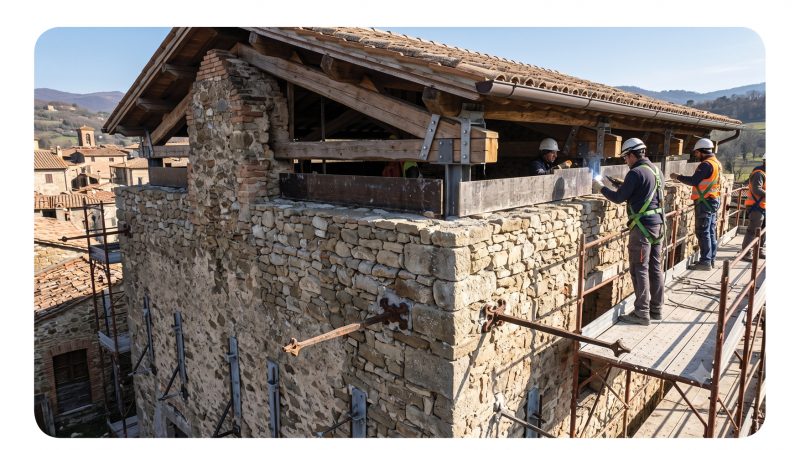
Interventions aimed at reducing deficiencies in connections are intended to improve the overall performance of masonry buildings, ensuring effective interlocking between walls, adequate connection between walls and floor slabs, and the proper transfer of horizontal forces within the structure. It is also necessary to verify that any thrusts generated by arches, vaults, and roofs are effectively counteracted, thereby eliminating potential mechanisms of structural failure.
The implementation of these measures is a fundamental prerequisite for the application of global seismic analysis methods, which assume box-like behavior of the building and the stability of the walls against out-of-plane forces.
Among the measures in this category, top-of-wall beams represent one of the most effective solutions for increasing structural continuity between walls and improving the connection to the roof. When properly designed and connected to the existing masonry, they facilitate more effective transmission of horizontal forces, limit out-of-plane overturning mechanisms of the top walls, and help absorb the thrusts generated by the roof.
The effectiveness of a curb depends on the continuity of the element, the quality of the connections to the masonry, and its mechanical and structural compatibility with the existing building. In historic buildings, it is generally not recommended to install curbs at intermediate levels within the masonry—particularly in rubble masonry—since the necessary demolition work may alter the original structural behavior.
This repository considers five main types of interventions: insertion of tie rods, insertion of hoop reinforcement, reinforced masonry curbs, steel curbs, and reinforced concrete curbs. Each solution has specific advantages, limitations, and areas of application; the choice of the most suitable intervention must therefore be based on a comprehensive assessment of the building’s characteristics, seismic mitigation objectives, and criteria for compatibility with the historic heritage.
1.1 Inserting tie rods
The installation of tie rods is one of the most established methods for improving structural connections in masonry buildings. Metal tie rods connect opposing walls or other structural elements, limiting the activation of local mechanisms and promoting a box-like behavior of the structure during an earthquake. In historic buildings, the design must ensure compatibility with the existing masonry and carefully verify the effectiveness of the anchors.
1.2 Inserting hoops
Bracing is a localized intervention designed to improve structural continuity at openings or in areas characterized by insufficient connections. Typically constructed using metal frames or profiles, it helps redistribute stresses and limit localized stress concentrations, while maintaining compatibility with the construction characteristics of the historic building.
1.3 Insertion of curbs in reinforced masonry
The reinforced masonry curb improves the connection between the walls and the roof structure while maintaining a high degree of compatibility with traditional construction techniques. When properly connected to the existing masonry, it enhances structural continuity, limits out-of-plane buckling mechanisms, and promotes the building’s box-like behavior during seismic events.
1.4 Insertion of steel curbs
The reinforced concrete curb enhances the continuity of the structural system and improves the building’s box-like behavior. In historic buildings, however, its use requires particular caution, as its high stiffness and increased mass can produce effects that are incompatible with the existing masonry. For this reason, its use must be evaluated on a case-by-case basis.
1.5 Insertion of reinforced concrete curbs
The reinforced concrete curb enhances the continuity of the structural system and improves the building’s box-like behavior. In historic buildings, however, its use requires particular caution, as its high stiffness and increased mass can produce effects that are incompatible with the existing masonry. For this reason, its use must be evaluated on a case-by-case basis.