


MTTM. Earthquake
2. Interventions aimed at reducing the thrust of arches and vaults and at their consolidation
2.1 Inserting chains
MTTM-HEA-2.1
Description
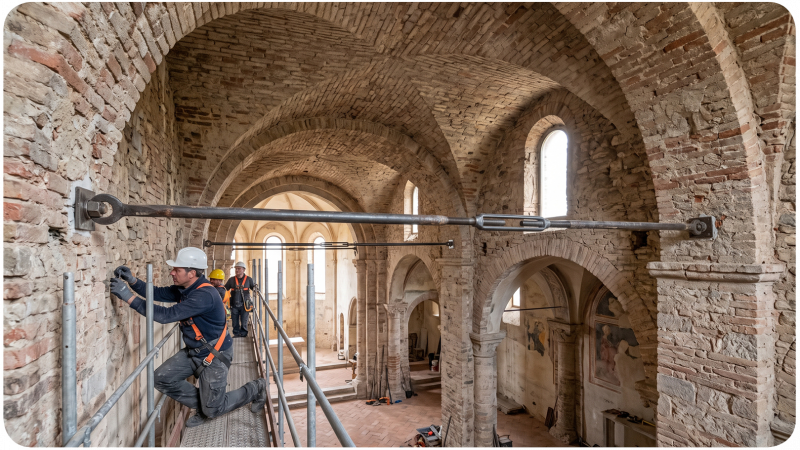
The installation of chains is one of the most tried-and-tested traditional methods for reinforcing arches and vaults in masonry buildings. The main aim of this intervention is to counteract the horizontal forces transmitted to the supporting masonry, limiting the mutual displacement of the masonry elements and contributing to the stability of the structural system. The tie rods are generally positioned at the haunches of arches and vaults, where they are most effective in counteracting the tensile forces generated by the thrusts. Where such positioning is not possible, alternative solutions may be adopted, such as installation on the extrados or at other levels of the structure, provided that specific design checks demonstrate their effectiveness and take into account the bending and shear stresses induced in the masonry. The intervention requires careful design and correct installation of the chains, which must be suitably pre-stressed to absorb part of the thrust, to be assessed through a preliminary structural analysis. Excessive pre-stress values may, in fact, lead to stress concentrations and localised damage. In historic buildings, particular attention must be paid to ensuring that the works are compatible with the existing structural features, minimising the impact on the historic fabric and prioritising solutions that can be inspected and, where possible, reversed.
Advantages
The installation of chains helps to counteract the forces exerted by arches and vaults on the supporting walls, preventing them from moving away from one another and helping to increase the building’s structural stability. This intervention is particularly effective in improving the building’s behaviour under seismic loads, limiting the tilting of walls and the out-of-plumb movement of the masonry. It is also a traditional, well-tried technique, characterised by relative simplicity of execution, generally low costs and good inspectability.
Disadvantages and limitations of applicability
The effectiveness of the chains depends significantly on their correct positioning, sizing and the quality of the anchors. Where it is not possible to position them at the springing points of arches and vaults, it is necessary to carefully assess the effectiveness of alternative solutions and the effects they have on the masonry. Furthermore, tie rods are not effective in counteracting instability resulting from foundation settlement and require periodic checks on their condition, protection against corrosion and the maintenance of the correct tension.
Synergies, interactions and opportunities for complementary interventions
Where damage is present in vaulted structures, it is generally advisable to carry out preliminary repair work, aimed at restoring the continuity of the masonry by injecting compatible mortar. In more complex cases, localised interventions may be necessary, such as the insertion of wedges or the reconstruction of areas affected by compression damage. Where arches or vaults exhibit significant deformation or loss of geometric integrity, the installation of tie rods may prove insufficient and must be supplemented by further consolidation works, such as sub-arches or other suitably designed reinforcement structures.
Assessment against the criteria
Applicabilità e impatti
Efficacy
Applicability
Environmental sustainability
Reversibility
Impact
Durability
****
***
*****
**
***
***
Logistica di cantiere e costi
Monetary cost
Construction complexity
Availability (time)
Execution time
Maintenance costs
Regionality
Integrative interventions
Use restriction
***
****
****
****
***
****
**
****
Processo produttivo
Degree of innovation
Sustainability
**
****
Relationship with the indicators of the Risk Analysis Model
Structural vulnerability: Arch and vaults.
Riferimenti
Doglioni, F., Moretti, A., & Petrini, V. (1994). Le chiese e il terremoto. LINT, Trieste.
Ministero della Cultura (2011). Linee guida per la valutazione e riduzione del rischio sismico del patrimonio culturale.
Ministero delle Infrastrutture e dei Trasporti (2018). Aggiornamento delle Norme Tecniche per le Costruzioni. D.M. 17 gennaio 2018.
Consiglio Superiore dei Lavori Pubblici (2019). Circolare n. 7 C.S.LL.PP.
ICOMOS (2003). Principles for the Analysis, Conservation and Structural Restoration of Architectural Heritage.
Lagomarsino, S., & Cattari, S. (2015). PERPETUATE Guidelines for Seismic Performance-Based Assessment of Cultural Heritage Masonry Structures.
Roca, P., Cervera, M., Gariup, G., & Pelà, L. (2010). Structural Analysis of Masonry Historical Constructions.
Tomaževič, M. (1999). Earthquake-Resistant Design of Masonry Buildings.
Valluzzi, M. R. (2007). Criteri e tecniche di consolidamento delle strutture murarie storiche.