


MTTM. UHI- Energy Efficiency. MIC 2015 Guidelines
Environmental quality in historic buildings
Introduction
Indoor Environmental Quality (IEQ) depends on the interaction between the individual and the physical environment, with particular reference to thermal and hygrometric, acoustic, lighting and air quality aspects. An objective assessment of well-being requires the measurement of physical parameters that influence not only comfort, but also the healthiness of the environment, energy consumption and the productivity of the occupants.
For the assessment of IEQ, reference is generally made to the UNI EN 15251 standard, which considers:
- thermal comfort;
- visual comfort;
- acoustic comfort;
- air quality.
In the case of historic buildings used as museums or exhibition spaces, the conservation requirements of cultural heritage must also be taken into account, particularly with regard to thermo-hygrometric and lighting parameters, as well as air quality.
Thermal comfort
Overall thermal comfort conditions are generally assessed using the PMV (Predicted Mean Vote) index, which relates to occupants’ thermal perception and is calculated on the basis of environmental and subjective parameters, such as air temperature, humidity, air velocity, mean radiant temperature, metabolic rate and clothing.
Associated with the PMV index is the PPD (Predicted Percentage of Dissatisfied), which expresses the predicted percentage of dissatisfied occupants.
Local thermal discomfort, on the other hand, may result from:
- vertical temperature differences;
- surfaces that are too hot or too cold;
- draughts;
- radiant asymmetries.
The PMV, PPD and local discomfort indices are governed by the UNI EN ISO 7730 and UNI EN 15251 standards
Visual comfort
The assessment of visual comfort in the workplace is primarily based on the UNI EN 12464-1 and UNI EN 15251 standards.
The UNI EN 15251 standard provides guideline values for maintained illuminance, glare and colour rendering, depending on the different intended uses of the spaces.
Acoustic comfort
Acoustic comfort is governed by numerous regulatory provisions, including the Prime Ministerial Decree of 14 November 1997 on noise pollution and the Prime Ministerial Decree of 5 December 1997 on the passive acoustic requirements of buildings.
Noise transmission can occur both via airborne sound and through vibrations transmitted by structures. Acoustic assessment therefore requires an analysis of both the building’s construction characteristics and the noise sources present in the environment.
The UNI EN 15251 standard also defines reference values for sound pressure levels for different intended uses.
Strategies for improving indoor environmental quality
Environmental quality can be improved through measures affecting the building envelope or the building services.
Measures affecting the building envelope include:
- thermal insulation of opaque surfaces;
- replacement or upgrading of windows and doors;
- sun-shading systems.
These measures influence the average radiant temperature and the operative temperature perceived by occupants, thereby improving comfort conditions.
With regard to building services, the UNI 10339 standard prioritises thermal comfort and air quality, providing for both prescriptive and performance-based design approaches.
The prescriptive method defines reference values for temperature, relative humidity, air velocity and ventilation rates; the performance-based method, on the other hand, requires verification based on compliance with standards UNI EN ISO 7730 and UNI EN 15251
Environmental requirements in historic museum buildings
In Italy, many museums are housed in historic buildings, which often present challenges in terms of building services, safety and environmental control.
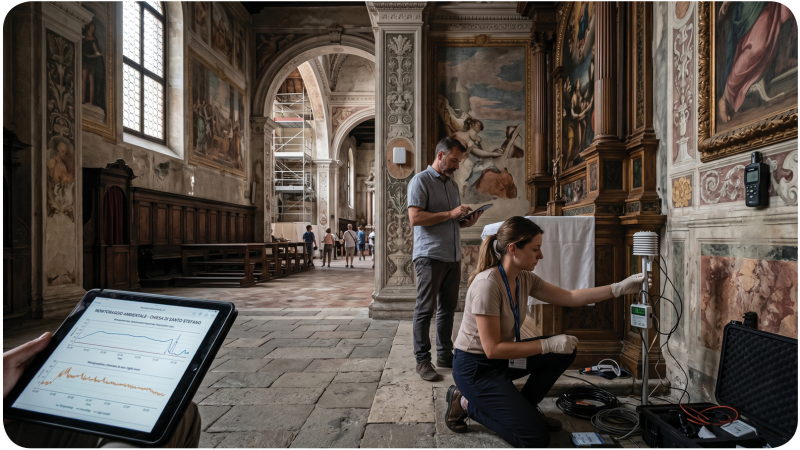
The conservation of cultural heritage requires the continuous monitoring of parameters such as temperature, relative humidity, lighting and air quality, as these are closely linked to the longevity of the works.
The Policy Document on technical and scientific criteria and on the standards for the operation and development of museums (Ministerial Decree of 10 May 2001) emphasises the need for museum facilities to be:
- flexible;
- controllable;
- maintainable;
- functional for the conservation of collections.
Of particular importance is the routine maintenance of buildings and systems, aimed both at the conservation of the works and at reducing energy consumption.
Among the most effective measures are:
- regular maintenance of window frames and fittings;
- sunlight filtering systems;
- reduction of uncontrolled air exchange;
- control of temperature, humidity and lighting levels.
Environmental monitoring can be supported by specific tools, such as the Environmental Data Sheet developed by ISCR, designed for the systematic collection of microclimatic and conservation data [Giani et al., 2005; 2006].
Particular attention must also be paid to ecclesiastical buildings, where conservation requirements must be compatible with liturgical functions and the comfort of users. In such contexts, access control, routine maintenance and the adoption of air-conditioning systems compatible with the conservation of the historical and artistic heritage are of great importance.