


MTTM. Urban Heat Islands and Energy Efficiency in Historic Buildings. MIC 2015 Guidelines
4. Application of films and screens
In.19. Application of solar control films to glass
MTTM-UHI_MIC-19
Description
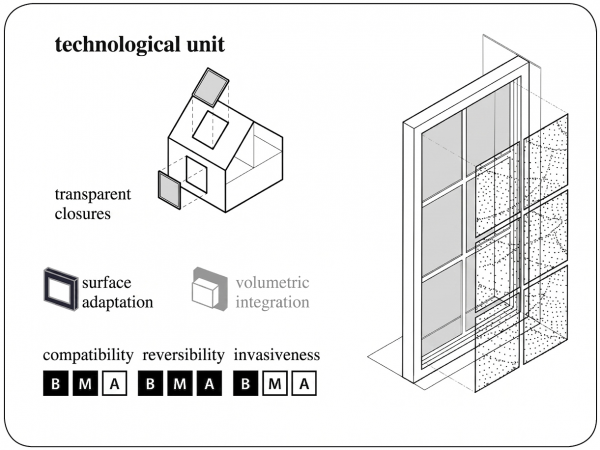
The measure involves the installation of solar control films to reduce heat gain through the transparent building envelope. The light transmission of the glass and the film must be such as to ensure the user’s visual comfort, whilst maintaining a daylight factor (FLD) of more than 2 per cent. There are two types of film: reflective film, which is silver in colour and has a slight mirror-like finish, to be applied to the outer pane; and semi-reflective film with a slight tint, to be applied to the inner pane as it is less resistant to weathering and environmental acidity.
Advantages
The fitting of a special film is a type of operation which, more than any other, allows the original aesthetic characteristics of the window or door to remain unchanged, as the film is transparent.
As it blocks almost all ultraviolet radiation, it is particularly suitable for buildings housing objects of high artistic value.
The installation of a solar control film significantly reduces the light transmission of the glass (50–60%): although it provides almost total protection against ultraviolet radiation and fairly effective blocking of the infrared spectrum, it allows almost the entire visible spectrum to pass through.
Disadvantages and limitations of applicability
In any case, an assessment of the condition of the existing window is required to determine the technical feasibility and cost-effectiveness of the work. It is important to assess the film’s colour rendering properties in accordance with the building’s function.
Films have varying levels of mechanical and chemical resistance and durability depending on the type of surface coating: their suitability must be assessed on a case-by-case basis.
The film must be fitted by specialist technical staff: incorrect application could lead to problems with the adhesion and uniformity of the adhesive, the chemical and physical compatibility between the film and the adhesive, and the durability of the film. Maintenance must be carried out using techniques and products compatible with the chemical, physical and mechanical resistance of the material.
Synergies, interactions and opportunities for complementary interventions
The cost-effectiveness of the work increases with the use of double glazing made of float glass, frames with good thermal insulation performance, and the absence of air infiltration at the joints between the glazing and the frame, between the fixed and movable sashes, and between the window and the wall cavity.
It may be necessary to combine this with insulation work and sealing of air infiltration at the frame. In. 11.
Assessment against the criteria
Applicability and impact
Efficacy
Applicability
Environmental sustainability
Reversibility
Impact
Quality of redevelopment
Durability
****
****
***
****
****
**
***
Cost and construction logistics
Monetary cost
Construction complexity
Availability (time)
Execution time
Maintenance costs
Regionality
Integrative interventions
Use restriction
***
**
***
****
***
***
***
****
Production process
Degree of innovation
Sustainability
*****
*****
Relationship with the indicators of the Risk Analysis Model
Formal vulnerability: Mitigations elements in the building – Roofs; Mitigations elements in the building – Facades.
Structural and building services vulnerabilities: Building envelope and its efficiency
References
UNI EN 15251:2008. Criteria for the design of the indoor environment and for the assessment of the energy performance of buildings, with regard to indoor air quality, thermal environment, lighting and acoustics
UNI 10339 (Italy). Air-handling systems for comfort purposes.