


Urban Heat Islands and Energy Efficiency in Historic Buildings. MIC 2015 Guidelines
2. Replacement of windows and installation of glass
In.13. Mechanization of existing or new window frames
MTTM-UHI_MIC-13
Description
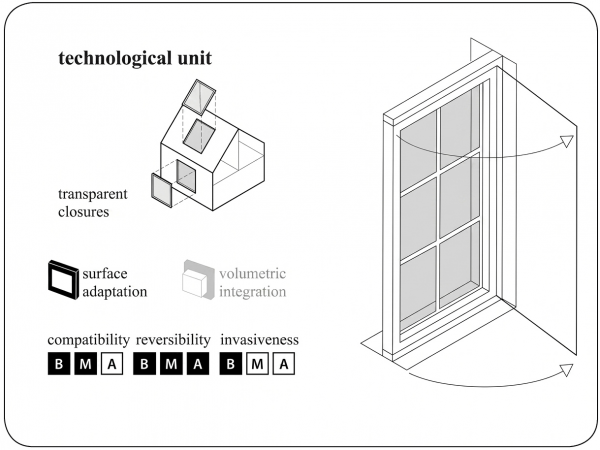
The mechanization of existing or new windows and doors is a measure designed to regulate natural ventilation. It allows the user to control the inflow and/or outflow of air driven by general pressure differences—primarily resulting from temperature differences between the interior and exterior and the action of the wind. What normally occurs in an uncontrolled manner through doors, windows, and shutters can be enhanced or inhibited based on specific design choices regarding the type and layout of windows, ducts, chimneys, and air intake and exhaust points. It is possible to increase natural ventilation through the use of mechanical opening devices controlled by carbon dioxide and water vapor sensors and/or based on thermal inputs from temperature and pressure sensors. The remote-controlled and home automation-based opening and closing of these devices, triggered by specific air quality, temperature, and pressure inputs, makes natural ventilation effective when properly designed.
Advantages
It is a method for controlling indoor comfort: effective, minimally invasive, and highly energy efficient.
Controlled natural ventilation systems allow for the regulation of thermal, humidity, and ventilation comfort in a building’s interior spaces.
Furthermore, in low-occupancy spaces, it is possible to control vapor concentration and thus prevent condensation and the growth of fungal colonies and mold, which can lead to aesthetic and hygiene issues.
Natural ventilation is also important from a safety and fire prevention perspective, as it limits the buildup of concentrations of flammable, explosive, or asphyxiating gases and chemical compounds.
Compared to the installation of a controlled mechanical ventilation system, energy consumption is related solely to the mechanization of the openings, while no air pretreatment takes place.
Disadvantages and limitations of applicability
Mechanized opening systems for windows and doors are compatible with buildings that have no restrictions on openings. Alternatively, it is possible to mechanize existing ventilation shafts or install newly designed ones. Many historic buildings have built-in ventilation systems that are often no longer in use; these can be put back into service by equipping them with smart remote controls.
Synergies, interactions and opportunities for complementary interventions
The amount of air introduced must be balanced against the air permeability of the window and door frames (In. 11) and the installation of frames with internal microventilation, or the intentional opening—whether manual or mechanized—of ducts and intake vents in ventilation systems and ventilation chimneys (In. 26), or the possible installation of controlled mechanical ventilation (CMV) systems. The quality and temperature of the air, in the absence of pre-treatment, can be controlled through evaporative cooling using external plant-based systems (In.22) or water misters for air intake.
Assessment against the criteria
Applicability and impact
Efficacy
Applicability
Environmental sustainability
Reversibility
Impact
Quality of redevelopment
Durability
****
****
***
****
****
**
****
Cost and construction logistics
Monetary cost
Construction complexity
Availability (time)
Execution time
Maintenance costs
Regionality
Integrative interventions
Use restriction
***
***
***
****
***
***
***
****
Production process
Degree of innovation
Sustainability
****
****
Relationship with the indicators of the Risk Analysis Model
Formal vulnerability: Mitigations elements in the building – Roofs; Mitigations elements in the building – Facades.
Structural and building services vulnerabilities: Building envelope and its efficiency
References
UNI EN 15251:2008. Criteria for the design of the indoor environment and for the assessment of the energy performance of buildings, with regard to indoor air quality, thermal environment, lighting and acoustics.
UNI 10339 (Italy). Air-handling systems for comfort purposes.