


MTTM. Flood. 1. Urban Redevelopment
1.1. Rain gardens
MTTM-FLO-1.1
Description
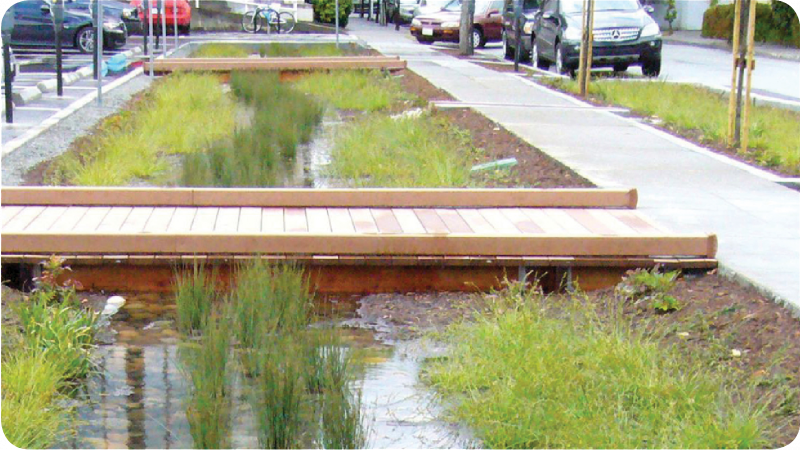
Rain gardens are green spaces designed to collect and retain rainwater runoff from impervious surfaces, such as roofs, roads, or parking lots, to facilitate its infiltration into the ground. These gardens consist of a selection of native, drought-tolerant plants capable of absorbing large amounts of water and helping to purify rainwater through natural processes. Rain gardens reduce surface runoff, helping to prevent local flooding and maintain water quality, while also promoting urban biodiversity.
Advantages
Rain gardens are green spaces designed to collect and retain rainwater running off impervious surfaces, such as roofs, roads or car parks, in order to encourage it to infiltrate the ground. These gardens consist of a selection of drought-resistant native plants capable of absorbing large quantities of water and helping to purify rainwater through natural processes. Rain gardens reduce surface runoff, helping to prevent local flooding and preserve water quality, as well as promoting urban biodiversity.
Disadvantages, critical issues, and the need for additional measures
They require regular maintenance, such as the removal of sediment, pruning of plants and cleaning of the soil, to maintain their efficiency. In densely populated urban areas, it may be difficult to find suitable space for the installation of rain gardens. Infiltration capacity depends on soil permeability; clay soils can limit absorption capacity. In the event of exceptional rainfall, the retention capacity may be exceeded, making a supporting drainage system necessary. Although they are generally cost-effective in the long term, design and installation costs can be high initially.
Assessment against the criteria
Applicability and impact
Efficacy
Applicability
Environmental sustainability
Reversibility
Formal and constructive impact
Quality of urban redevelopment
SDGs number
Durability
****
****
****
***
***
****
3
****
Cost and construction logistics
Monetary cost
Construction complexity
Availability (time)
Execution time
Maintenance costs
Regionality
Use restriction
****
***
****
****
****
***
****
Production process
Degree of innovation
Sustainability
*
****
Relationship with the indicators of the Risk Analysis Model
Local hazard: Local territorial conditions / ground cover.
References
xxx