


Methodologies, Technologies, Techniques and Materials for Fire Prevention and Mitigation
Fire is one of the most destructive risks to historic heritage, as it can cause serious damage in a very short space of time, compromising both the structural safety and the cultural value of buildings. Historic buildings often contain combustible materials, whilst even masonry and stone elements can suffer a significant loss of mechanical performance at high temperatures, sometimes without any immediately visible signs.
The dynamics of a fire are influenced by the point of ignition, the building’s construction characteristics and the dense urban layout typical of historic centres – factors which can facilitate the rapid spread of fire between rooms and adjacent buildings. Although fire safety regulations exist in many countries, these often fail to adequately address the specific vulnerabilities of cultural heritage.
This section of the repository outlines the main measures that can be implemented to prevent and mitigate fire risk, organised into five broad categories:
1. Urban prevention systems
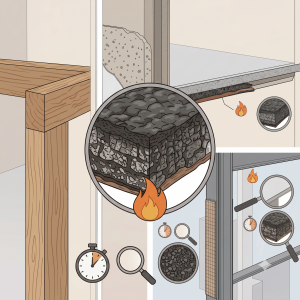
2. Interventions for structural fire resistance and fire reaction of non-structural coating systems
3. Interventions aimed at improving the reaction to fire of non-structural elements
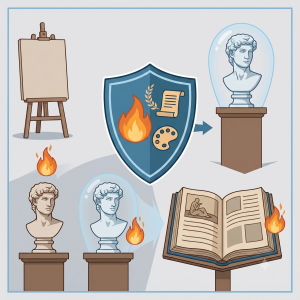
4. Interventions for the protection of elements of cultural and historical significance
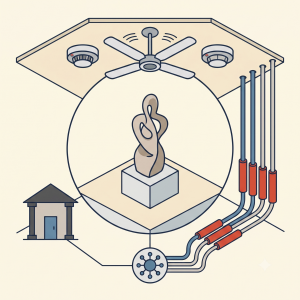
5. Fire management systems.
Fire resistance
The main parameters for assessing the behaviour of a building, its structural elements and the movable property contained within it are fire resistance and reaction to fire.
Depending on their intended use, building materials and products must be assessed and classified according to their reaction to fire and their fire resistance to be considered suitable and usable for fire prevention.
The Methodologies, Technologies, Techniques and Materials (MTTM) for fire risk mitigation must take these two fundamental parameters into account, in accordance with the performance required of the various building elements and the assets to be protected.
Fire resistance is the set of characteristics of a structural element which, in the event of a fire, defines its ability to maintain stability, resistance to combustion products and thermal insulation for a specified period. Fire resistance is a parameter typically applied to load-bearing structures.
To assess these characteristics, the European standard UNI EN 13501-2 ‘Classification of products and construction elements in relation to fire – Part 2: Classification based on the results of fire resistance tests, excluding ventilation systems’ uses three different variables summarised by the acronym ‘REI’:
R | Structural Stability / Load-bearing Capacity
The ability of a structural element to bear the loads present under standardised and non-standardised fire conditions for a certain period of time.
E | Sealing / Airtightness / Integrity
The ability of a building or structural element to prevent the passage of smoke and hot gases under standardised and non-standardised fire conditions for a certain period of time.
I | Thermal Insulation
The ability of a building or structural element to limit the transfer of heat from a standardised fire and non-standardised fire for a certain period, whilst maintaining the temperature measured on the side not directly exposed to the fire (cold side) below a specified threshold.
The degree of structural stability, according to European standards, is denoted by the variable ‘R’ followed by a number indicating, in minutes, the duration for which the structure can withstand loads under standard fire conditions. These parameters are known as Fire Resistance Classes, categorised into the following time ranges, as mentioned, expressed in minutes: 10, 15, 20, 30, 45, 60, 90, 120, 180, 240, 360.
In the case of structural elements that serve both a partitioning and a structural function (e.g. walls and floors), the variables ‘E’ for Sealing and ‘I’ for Thermal Insulation are added to the variable ‘R’.
Therefore:
- the symbol “REI” identifies a structural element that must maintain, for a specified period, its stability, integrity and thermal insulation;
- the symbol “RE” identifies a structural element that must maintain, for a specified period, its stability and integrity;
- the symbol “R” identifies a structural element that must maintain only stability for a specified period.
In protected cultural heritage sites (Ministerial Decree of 10 July 2020, Ministerial Instruction of 14 October 2021), structural elements must ensure fire resistance compatible with the safety of people. However, it is not always possible to bring them up to modern standards without compromising their historical and artistic value. In such cases, a performance-based approach is applied:
- compensatory measures are assessed, such as additional fire compartments, detection and suppression systems, and safe escape routes
- a fire resistance rating lower than that prescribed for new buildings may be accepted, provided that the overall risk remains acceptable.
In historic contexts, direct interventions on load-bearing elements are restricted for conservation reasons; consequently, the scope for action is constrained by the need to preserve the integrity, material composition, aesthetic characteristics and reversibility of the interventions.
Some of these MTTMs can contribute both to improving fire behaviour and to increasing the fire resistance of building elements, depending on the characteristics of the material, the thickness applied and the structural element concerned.
Depending on their area of application, building materials and products must be assessed and classified according to their reaction to fire and their fire resistance to be considered suitable and usable for fire prevention.
Reaction to fire
Reaction to fire is a measure of passive protection that describes how a material behaves when, when subjected to a standardised fire, it contributes to a greater or lesser extent to the development and spread of the fire. It is of particular importance for building materials, finishes and furnishings.
It is a parameter specifically relating to materials used in construction, with particular emphasis on finishing and cladding materials, panelling, suspended ceilings, decorations and the like, and also extends to furnishings, curtains and textiles in general.
In Italy, Ministerial Decree of 26 June 1984 was the first to establish standards, criteria and procedures for the classification of fire reaction and the type approval of materials for fire prevention purposes, excluding the risks arising from the fumes emitted by the materials themselves in the event of a fire.
The classification system consists of Euroclasses, ranging from A1 to F, where A1 covers non-combustible products and F covers products that are unclassified or do not meet the criteria for any of the other classes (Euroclasses: A1 / A2 / B / C / D / E / F).
In addition, two complementary parameters are also provided for:
- S refers to the level of smoke emission. Products classified as s1, unlike those classified as s3, produce small amounts of smoke. The smoke is released slowly.
- D indicates the tendency to produce incandescent droplets or particles that may spread the fire
In listed cultural heritage properties, as provided for by the Ministerial Decree of 10 July 2020 and the Ministerial Instruction of 14 October 2021, verification of materials’ fire reaction requirements is not always mandatory in the same way as it is in modern buildings. This is because, in historic buildings, it is not always possible to replace existing materials or add invasive protective measures without damaging the property.
Any material that is added or replaced (flooring, walls, false ceilings, cladding, fixed and movable furnishings, curtains) must comply with the fire reaction class set out in the Fire Prevention Code (Ministerial Decree of 3 August 2015, Annex II).
However, there is no requirement to replace historic materials that do not meet the fire reaction requirements. Instead, it must be demonstrated, through a performance-based risk assessment, that the intervention does not increase the overall fire risk.
It is possible to carry out work on non-structural elements to improve their fire reaction.
Division of spaces
In historic buildings, fire risk management is implemented through active detection, ventilation and suppression systems. However, these systems alone are not sufficient; they must be supplemented by passive prevention strategies capable of limiting the spread of fire and combustion products.
Fire compartmentalisation plays a fundamental role, particularly in contexts characterised by high cultural value, complex layouts and combustible materials.
Compartmentalisation involves dividing the building into functionally independent sections, delimited by structural elements with adequate fire resistance, with the aim of: •
- to limit the spread of flames;
- to reduce the spread of smoke and hot gases;
- to confine the damage to a limited area of the building;
- to allow more time for evacuation and for the emergency services to respond.
In museum and archival contexts, it helps to protect collections of particularly valuable items, thereby reducing the extent of potential damage.
Fire compartmentalisation is a fundamental passive prevention strategy aimed at limiting the spread of fire, smoke and hot gases within a building. In historic buildings, compartmentalisation presents specific challenges, as the construction of new walls, floors or partitions may conflict with the architectural and artistic values of the property.
An integrated system is therefore implemented, comprising both structural and non-structural elements.
Load-bearing walls, floors and other structural elements contribute significantly to the separation of compartments thanks to their mass and thermal inertia; however, due to conservation constraints and the absence of certification to modern standards, they do not always guarantee the required performance levels on their own.
In such cases, non-structural elements play a key role, enabling the building’s fire performance to be improved through reversible, targeted interventions that are compatible with conservation requirements, whilst ensuring the continuity of fire compartments and the protection of points of discontinuity, such as openings, service penetrations and internal partitions. Such measures, which are generally reversible and have a low impact, improve the overall effectiveness of the fire compartments without altering the building’s historical and architectural values.
The specific methodologies, technologies and techniques relating to structural and non-structural elements are set out in detail in the relevant MTTM guidelines.
Structural elements contribute significantly to the separation of fire compartments thanks to their mass and thermal inertia; however, due to conservation restrictions and the lack of certification to modern standards, they do not always guarantee the required performance levels on their own.
In such cases, non-structural elements play a fundamental role, enabling the building’s fire performance to be improved through reversible, targeted interventions that are compatible with conservation requirements, whilst ensuring the continuity of compartmentalisation and the protection of points of discontinuity, such as openings, service penetrations and internal partitions. Such interventions, which are generally reversible and have a low impact, make it possible to improve the overall effectiveness of the fire compartmentalisation without altering the building’s historical and architectural values.
The emergency response team
In historic and cultural buildings open to the public — such as museums, libraries, archives and churches — the role of staff is crucial not only for the safety of visitors, but also for the protection of cultural artefacts and heritage. This indicator relates to the presence, organisation and training of staff responsible for fire prevention and management.
In practice, staff must be able to:
- Understand and implement emergency plans, including escape routes, fire compartments and sensitive areas, to ensure safe evacuations and rapid response.
- Undergo continuous training and practice, acquiring skills in the use of detectors, automatic fire-extinguishing systems, fire extinguishers and the management of critical situations.
- Coordinate roles and responsibilities, both internally and with external bodies such as the Fire Service, to ensure effective responses and minimise harm to people and property.
- Monitor visitor flows and daily activities, preventing behaviour or conditions that may increase the risk of fire.
Although it is not a specific MTTM to be implemented, staff are a critical element of functional safety: the presence of advanced fire-fighting systems is not enough if staff are not trained, aware and ready to respond promptly in the event of an emergency, whilst at the same time protecting both people and cultural heritage
Space distribution typology
The layout typology refers to the functional organisation of a building’s interior spaces and represents the operational aspect of fire compartmentalisation, often referred to as ‘functional’. It does not depend on physical barriers, but on the management of spaces, intended uses and the flow of people and materials, with the aim of reducing the risk of fire spread and ensuring the safety of people and property.
Unlike other fire safety measures based on structural elements or systems, this component almost never involves specific physical interventions; consequently, there are no ‘standard’ fire safety measures to be applied.
However, certain elements of functional compartmentalisation may be regarded as conceptual or operational fire safety measures, as they contribute directly to fire safety:
- the separation of areas according to their intended use, for example by locating storage areas for combustible materials away from public access areas or exhibition halls;
- the designation of evacuation routes, with corridors, staircases and exits designed to minimise risks in the event of a fire;
- the provision of buffer zones or intermediate areas, which help to limit the spread of smoke, heat and flames between adjacent compartments;
- the operational management of the flow of people and materials, including the scheduling of activities and movements to reduce the overall risk.
Assessing the distribution pattern therefore makes it possible to quantify the effectiveness of compartmentalisation without altering the physical structure, whilst complementing passive solutions (fire-resistant building elements) and active prevention and detection methods. In historic buildings, this aspect is particularly important, as it enables fire safety to be improved without compromising their historical and architectural value.
References
CEN/TC 346 (Comitato Tecnico Europeo per la Conservazione dei Beni Culturali), s.d. Serie di norme sulla conservazione del patrimonio culturale (es. EN 15898). Bruxelles: CEN.
ICC (International Code Council), 2024. International Existing Building Code (IEBC) 2024. Country Club Hills, IL: International Code Council.
ICC (International Code Council), 2024. International Fire Code (IFC) 2024. Country Club Hills, IL: International Code Council.
NFPA (National Fire Protection Association), 2022. NFPA 914: Code for the Protection of Historic Structures. Edizione 2023. Quincy, MA: National Fire Protection Association.
UNESCO, 2024. Fire Risk Management for Cultural and Natural Heritage Sites. Parigi: UNESCO.
Advisory Council on Historic Preservation & General Services Administration, 1989. Fire Safety Retrofitting in Historic Buildings. Washington, DC: ACHP/GSA.
Artim, N., 2018. Fire: Its Impact on Historic Buildings and Cultural Heritage Properties. Washington, DC: Smithsonian Cultural Rescue Initiative.
Kidd, S., 2020. Heritage Under Fire: A Guide to the Protection of Historic Buildings. 3ª ed. Londra: Fire Protection Association.
National Bureau of Standards, 1942. Fire-Resistance Classifications of Building Constructions. Building Materials and Structures Report BMS 92. Washington, DC: U.S. Department of Commerce.
UNI EN 13501-2:2023. Title of the standard on fire classification and resistance. Milan, Italian Standardisation Body (UNI), 2023.
Ministerial Decree of 26 June 1984: Classification of reaction to fire and type approval of materials for the purposes of fire prevention (Official Gazette No. 234 of 25 August 1984 – Ordinary Supplement).
Ministry of the Interior, Decree of 3 August 2015. Approval of technical standards for fire prevention, pursuant to Article 15 of Legislative Decree No. 139 of 8 March 2006 (Official Gazette No. 192 of 20 August 2015 – Ordinary Supplement No. 51).