


Methodologies, Technologies, Techniques, Materials. Evaluation Criteria
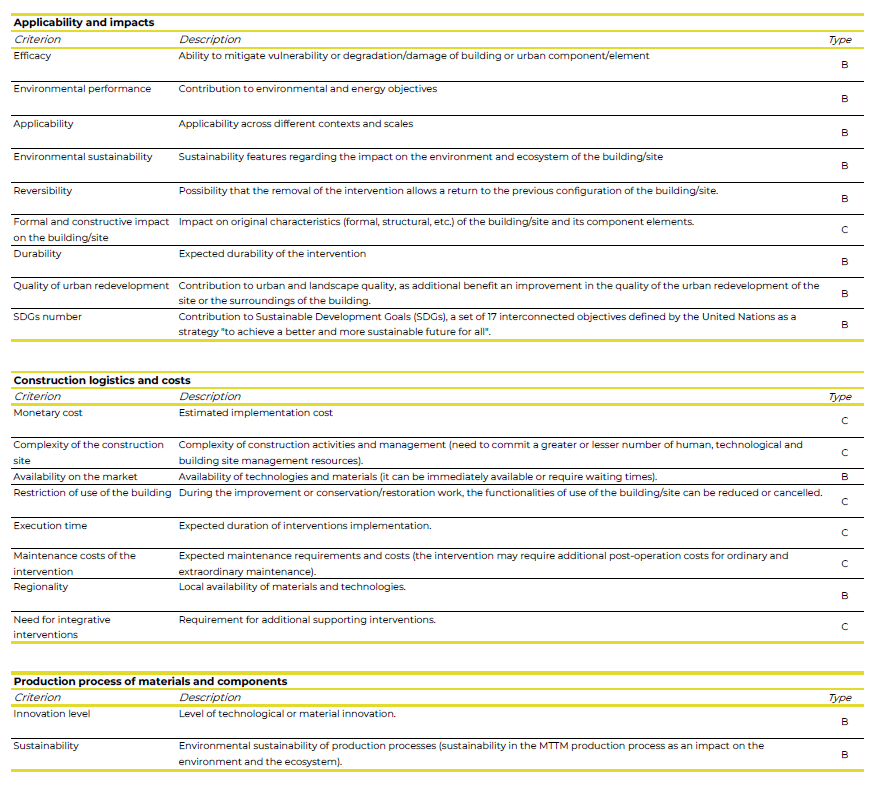
The performance of Methodologies, Technologies, Techniques, and Materials (MTTM) is evaluated based on criteria divided into three broad categories:
- Applicability and impact on the building and site: effectiveness, applicability, reversibility, environmental sustainability, durability, impact on the building structure;
- Costs and site logistics: economic/monetary cost, operational complexity of the site, market availability, execution time, maintenance cost, limitations on use, need for additional interventions;
- Sustainability of the production process: degree of innovation of the MTTM, sustainability of the production process
The criteria can be benefit-based or cost-based: in the former case, better performance of the MTTM corresponds to a greater benefit; in the latter, to a lower cost. For example, a benefit of an MTTM may be its “mitigation effectiveness,” understood as the ability to reduce a structural element’s vulnerability to earthquakes or to reduce a site’s flood risk. Costs are not limited solely to the economic aspects associated with implementing the MTTM (required human resources, equipment costs, labor, etc.), but also include the impact of the intervention on the building or site, the need for future maintenance, or the time required for execution.
In the context of historic buildings (whether listed or not), there will be MTTMs that may not be applicable due to preservation restrictions that must be observed, excessive impact on the building, lack of reversibility, and others that can only be adopted after thorough evaluations.
The performance of MTTMs relative to individual criteria is important when evaluating one MTTM against another, but the “weights” assigned to these criteria can also be significant, as they reflect the perspective of the expert or decision-maker, who may determine that one criterion is more important than another. Weights can be calibrated on a case-by-case basis when a set of MTTMs is applied in a specific context (for example, cost and resource criteria may be more relevant than execution time, etc.).
The criteria form the basis for the comparative evaluation of MTTMs within multi-criteria decision-making processes. Criteria can take one of five values within the range: very low (*), low (**), medium (***), high (****), very high (*****). Some criteria take values on different scales (e.g., “Number of SDGs” is an integer value).
The evaluation criteria are described in the table below (Type B = benefits, type C=costs).