


MTTM. Flood. 4. Coastal flood mitigation / storm surge interventions
4.5. Beach nourishment
MTTM-FLO-4.5
Description
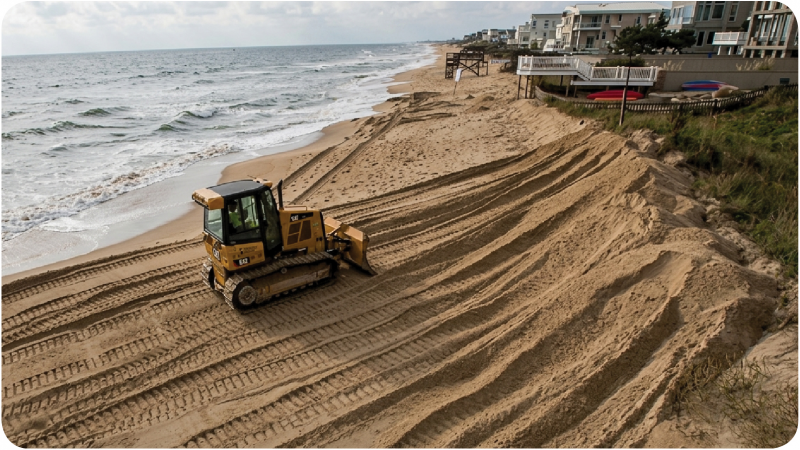
Beach nourishment is a coastal defence technique that involves adding sand or other granular materials to rebuild or widen eroded beaches. This solution is used to combat coastal erosion and protect nearby infrastructure, whilst improving the appearance and functionality of the beaches. The material used for beach nourishment is generally sourced from external deposits, such as seabeds, riverbeds or dredged areas, and is distributed along the beach to restore the eroded shoreline. Beach nourishment is considered a ‘soft’ coastal defence solution, as it does not involve the construction of permanent rigid structures, and is often preferred in tourist areas to maintain the attractiveness of beaches without altering their natural appearance.
Given the predicted rise in sea level over the coming decades, it will be necessary to evaluate beach nourishment techniques that can progressively counteract this problem. In order to preserve the coastal environment, the raising of extensive areas of the coastline by tens of centimetres must be considered. This may also entail the implementation of coastal development works that take into account the beach-to-inland ratio (see, for example, the ‘murazzi’ solution implemented along the Pellestrina-Venice coastline). In extreme cases, the inevitable loss of certain beach areas may also have to be considered.
Advantages
Beach nourishment provides protection against coastal erosion, helping to maintain beaches and protect nearby infrastructure from storm surges and rising sea levels. This technique restores eroded beaches, improving the appearance and functionality of coastal areas, making them more attractive to tourists and residents. By adding material to the beach, beach nourishment increases the coast’s ability to withstand extreme weather events, reducing the impact of waves and storm surges. Compared to rigid structures such as breakwaters or groynes, beach nourishment is a less invasive solution that does not permanently alter the natural coastal environment. Beach nourishment can be repeated as needed and depending on erosion conditions, and is easily reversible, as it does not involve permanent structures.
Disadvantages, critical issues, and the need for additional measures
Beach nourishment can be costly, especially if it needs to be repeated frequently over time. Finding suitable materials for nourishment can be difficult and expensive. The material must be compatible with the existing beach to avoid ecological damage. The process of dredging and spreading sand can temporarily disturb marine ecosystems and species living along the coast, such as turtles or seabirds. Beach nourishment provides a temporary solution to erosion. In the long term, the beach will continue to erode, particularly where accelerated erosion is occurring. Adding large quantities of sand can alter local currents and the natural transport of sediments, causing potential erosion problems in nearby areas. It requires frequent monitoring.
Assessment against the criteria
Applicability and impact
Efficacy
Applicability
Environmental sustainability
Reversibility
Impact
Quality of redevelopment
SDGs number
Durability
****
***
****
**
****
****
5
***
Cost and construction logistics
Monetary cost
Construction complexity
Availability (time)
Execution time
Maintenance costs
Regionality
Use restriction
***
**
*****
***
***
****
****
Production process
Degree of innovation
Sustainability
***
****
Relationship with the indicators of the Risk Analysis Model
Local hazard: Risk contrast, natural / artificial elements.
References
xxx